How Vincit Built a Data-Driven Organization
Using the transformation of his own company as an example, Jakub Rudzki the CIO at Vincit explains why data-driven decision-making is essential for modern organizations, how the transformation process unfolded, and the key lessons the company learned along the way.
We invite you to read the case study and discover Vincit’s practical insights and experience.
Case study przygotowane przez:

Intrduction
The ability to make informed decisions based on data rather than intuition is essential—especially in times of uncertainty. At Vincit, we usually help other companies transform their systems and processes to support business growth. However, we are also a company ourselves, and we recently underwent our own data-driven business transformation at Vincit. This article outlines the key aspects of that journey: why we did it, how we approached it, and what we have learned so far.
Background
In July 2022, Vincit merged with Bilot, marking a significant milestone for both companies. I was responsible for leading the technology workstream of the integration process, and—as you might expect—even though we had spent months preparing for the merger, not every detail was in place. We had the essentials covered: our employees were paid on time, and our clients were invoiced without disruption. We implemented numerous changes to our internal systems and processes, and overall they functioned well. However, many of our systems were still not integrated. The work of integrating systems and harmonizing processes continues and could easily be the topic of a separate blog post. What we needed most at that point was a reliable view of where our business was heading.
At the time of the merger, Vincit’s system landscape was still quite fragmented. We had just implemented a new Professional Services Automation (PSA) system, which was unfamiliar to most users. We migrated customer data from Bilot’s two CRM systems into Vincit’s primary CRM. We also operated multiple accounting systems across different legal entities and countries. Most of our master data—including cost centers and chart of accounts—had not yet been standardized. This lack of consistency resulted in significant manual effort in financial reporting while also limiting the business insights we needed to make informed decisions.
Making fast decisions
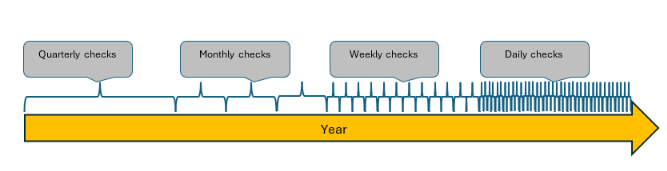
n 2022, our only formal business checkpoints were tied to the publication of financial results for investors. While we prepared monthly reports, the rapidly changing global market required more frequent business reviews—and ones that went beyond financial figures alone. We wanted a comprehensive set of business KPIs for the entire company. Our goal was to make this data available initially 12 times a year, then 52 times a year, and ultimately support a daily decision-making process. We also needed data at the business area level rather than at the legal entity level, as we operated through eight legal entities at one point. This need became the catalyst for a company-wide business transformation and a new approach to decision-making. To equip our organization with the tools to make better-informed decisions more frequently, we launched an internal initiative called Data Driven Vincit.
Project Data Driven Vincit
The Data Driven Vincit (DDV) project began in early 2023. Initially, its primary objective was to improve operational expenditure (OPEX) forecasting. However, in the autumn of 2023, the project’s vision was redefined and significantly expanded by our new CFO, Kimmo Kärkkäinen. We relaunched the initiative with a broader scope that extended beyond traditional financial reporting to include sales, projects, consultants, and other targeted reports, enabling decision-makers to better understand the performance of their respective business areas. At that point, I was appointed to lead the project.
In many ways, DDV resembled the transformation projects we deliver for our clients, with one key difference—we were transforming our own organization. One might assume that, with a highly skilled team of consultants in-house, we would rely solely on internal resources. However, because our consultants were also committed to client engagements, we assembled a hybrid team of internal and external experts. The project team included specialists in:
- Integration – to collect data from our various systems
- Data warehousing – to transform and consolidate data
- Reporting – to visualize data through dashboards and reports
- Platform engineering – to manage deployment pipelines, security, and infrastructure
- Finance – to support financial calculations, including cost allocation
- Planning – to implement and maintain a unified planning tool across the company
We initially planned to work in sprints. In reality, however, the project evolved into a continuous flow of changing requirements, operating much closer to a Kanban model than to traditional Scrum sprints. As the business gained greater visibility into the data, new issues emerged in our original assumptions, and stakeholders frequently requested additional functionality. As a result, throughout Q4 2023 and Q1 2024, we continuously released updates and refined the solution based on user feedback. By Q2 and Q3 2024, sprint planning and delivery had become significantly more stable.
I mention this because, although we understand what a well-executed agile project should look like, reality often differs from theory. Our primary objective was to provide the business with the right tools, and we continuously adapted the project to serve that goal.
From a governance perspective, the DDV project was sponsored by our CFO, while the entire Vincit Executive Team served as the steering committee. This structure enabled rapid decision-making and strong executive support, but it also came with equally high expectations regarding the speed and quality of delivery.
Technology
Our technology choices reflect the technology stack we frequently implement for our clients. At the same time, each individual solution can be relatively easily replaced with alternatives, depending on a company’s overall enterprise architecture.
We chose to build our data warehouse on the Microsoft Azure platform. We use Azure Function Apps to extract data from most of our source systems, with data typically refreshed at least once a day. Our ETL processes are orchestrated using Azure Data Factory, while Power BI serves as the presentation layer for reporting and data visualization.
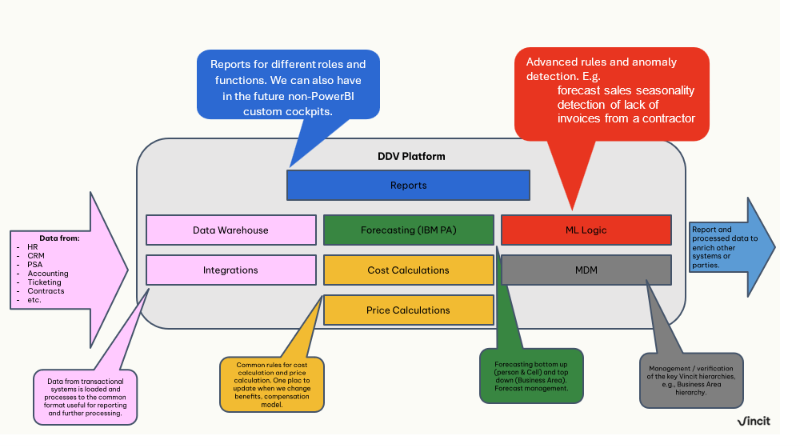
Overview DDV platform
Data and processes
The main challenges we faced during the DDV project were not technical—they were primarily related to data quality and data governance.
For example, many of the decisions regarding our Professional Services Automation (PSA) system, Severa, had been made during the integration project in the first half of 2022, when we merged data from three different Vincit and Bilot systems. As the project progressed, we found it necessary to revisit and refine some of those decisions. One improvement was significantly reducing the number of hour types, which in practice represent the consulting services we sell.
Secondly, we needed to clearly define and implement systems of record for different types of data. For instance, although our CRM was logically the master system for customer data, it was initially not integrated with our PSA platform. We therefore connected the two systems and began improving data consistency by eliminating duplicates and aligning customer ownership across systems.
We also identified data dimensions—such as cost centers and profit centers—that existed across multiple systems but lacked a single authoritative source for management and maintenance.
Finally, because some of our systems were not technically capable of enforcing certain business rules, we had to rely on user training and documentation to ensure consistent processes. Especially during the early stages of the project, technical limitations meant that users had to perform manual steps to maintain data consistency. For example, due to legacy integrations, our project managers had to manually link projects across two systems in specific scenarios. This illustrates a common real-world challenge: introducing temporary manual workarounds to ensure reliable data until a fully automated solution can be implemented. Ultimately, however, full automation remains the long-term objective
Where are we now?
As I write this article, it has been approximately one year since the Data Driven Vincit (DDV) project was relaunched. So, where are we today? I would say that we have successfully delivered a wide range of tools to the business, and our core objectives have been achieved. Some of the key outcomes include:
- Finance: We now have a comprehensive financial view of both top-line and bottom-line performance—not only at the legal entity level, but also across internal business areas and markets. We can drill down to customer and project profitability.
- Forecasting: Our finance team has implemented and now runs a monthly forecasting cycle across all business units. This was primarily a process transformation, with our new forecasting tool serving as an enabler rather than the driver of change.
- Sales: Our sales teams have access to sales forecasts and performance metrics by business area, customer, and project.
- Project management: Project managers and business area leaders can monitor project performance, identify risks, and track how projects evolve over time.
- People management: Team leaders can plan and monitor the performance of their teams.
- Sustainability reporting: We have successfully addressed the majority of our CSRD reporting requirements.
While these outcomes reflect the specific needs of our consulting business, many of the underlying principles are applicable to organizations across different industries. The data sources may differ, but the approach remains the same.
That said, our backlog is still extensive. As more users adopt the reports, they continue to identify new requirements, ideas, and opportunities for improvement.
We will continue enhancing our reporting capabilities and refining our business processes.nacznie lepsze narzędzia wewnętrzne niż w lipcu 2022 roku i że wkrótce będą one miały widoczny wpływ na wyniki naszego biznesu.