Start with Data Quality: How to Prepare Your Company for AI Without Burning Your Budget? – Case Study: DataRiseLab
During the second meeting of the SPCC Digital Transformation Committee, we had the opportunity to explore a case study prepared by DataRiseLab, demonstrating how proper data preparation forms the foundation for successful AI implementation and enables organizations to manage the entire adoption process more effectively.
We invite you to read the full case study.
Case study presented by:


Start with Data Quality: How to Prepare Your Company for AI Without Burning Your Budget?
Why do most corporate AI projects fail, and what is the main reason?
The pressure is real. The success rate is not.
Every competitor is talking about AI. Every vendor promises transformation. Every board is asking the same question: “Where is our AI strategy?” The pressure to act is enormous – and acting quickly without the right foundations is exactly when budgets get burned.
The statistics leave little room for illusion. More than 80% of AI projects fail – twice the failure rate of non-AI IT projects (RAND Corporation). Gartner reports that fewer than half of them (48%) are ultimately launched into day-to-day business operations. And 42% of companies are now abandoning most of their AI initiatives, compared with 17% a year earlier (S&P Global).
It is worth pausing on one point: these figures come from organizations with dedicated data teams, large budgets and entire departments focused on AI. If they are struggling at this scale, what happens in a 200-person company entering AI without preparation?
So why does this keep happening? The answer is data readiness. More than half of organizations identify data quality as the biggest barrier to AI adoption, and only 12% believe their data is truly good enough to use. This means roughly nine out of ten companies are building on a foundation that is not ready – and most discover it only after spending money. In reality, 85% of AI models fail because of poor or missing data. Not because of bad algorithms. Because of bad data.
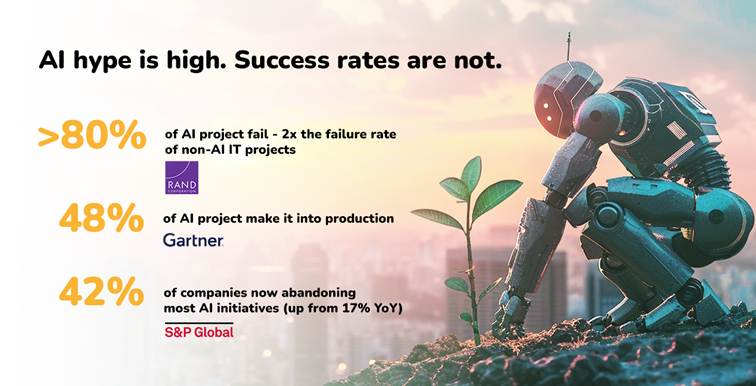
AI project failure statistics around the world.
Why do experts compare artificial intelligence to an engine and data to fuel?
The simplest way to explain this to a management team is through a metaphor. AI is an engine – and like any engine, its performance is strictly limited by the quality of its fuel. Today’s engines, such as GPT, Claude, Gemini, or specialized predictive systems, are technologically excellent. However, their performance and business effectiveness remain strictly limited by the quality of the fuel, which in most companies is simply not ready to use.
In most companies, data is scattered across disconnected systems. The customer database stores one version of the truth; finance has another; sales tracks information in spreadsheets; operations works with yet another set of numbers. Data is full of incorrect entries, gaps, and values that look different across systems – not because anyone did anything wrong, but because the data is raw. It has not been cleaned.

AI is an advanced engine, but its performance depends solely on the quality of the data you feed it.
Pour bad fuel into a good engine, and it will not only perform worse – it will break in specific, predictable ways:
- Overfitting – the model memorizes the past instead of learning from it. Like a student who memorized last year’s exam answers and fails when the questions are phrased differently. In practice: a demand forecast perfectly fitted to last year’s sales but completely missing the current quarter’s trend.
- Blindness to edge cases – the model handles 90% of standard cases well but makes serious mistakes in the ones that matter most. Like a spellchecker that works for everyday words but does not recognize the name of your biggest customer.
- Training-production mismatch – this is the problem that burns the most budget. The model works brilliantly in tests, where every record was clean, but falls apart in the real world. In production, it turns out that 30% of customer profiles are missing key fields, and the model was never prepared for that reality.
You would not pour dirty fuel into a Ferrari and blame the engine when it stalls. Yet this is exactly what most organizations do with AI.
Are data imperfections normal in companies with up to 500 employees?
In most organizations with 50 to 500 employees, the data reality looks more or less like this:
- Your CRM is only partially filled in, and different people complete it in different ways.
- Your ERP contains workarounds that no one documented, but everyone knows about.
- Critical knowledge lives in people’s heads, not in systems.
- You have data in five or more systems that do not talk to each other.
- As a company, you have never agreed on what “active customer” or “lead time” actually means.
This is not a failure – it is the starting point. You built these systems to serve the business, and they did their job. But it means one thing: before you build anything with AI, you need to understand what you are actually working with. AI will not fill gaps you do not know about – it will operate on what you feed it and provide confident-sounding answers based on incomplete data.
What is operational debt, and how does it affect AI implementation?
Operational debt is the difference between the theoretical flow of processes in a company – how processes look on paper – and how they work in practice. It includes manual system workarounds, undocumented procedures in CRM/ERP systems, and critical knowledge that exists only in the team’s heads. Although this temporary structure allows the company to function, it creates a serious and costly barrier when the organization attempts to automate.
Artificial intelligence does not eliminate operational debt; it dramatically exposes it and accelerates its negative effects. AI performs assigned tasks mechanically, at scale, and with complete confidence. If the system is fed chaotic procedures or inconsistent rules, the organization will simply receive very fast, large-scale operational chaos.
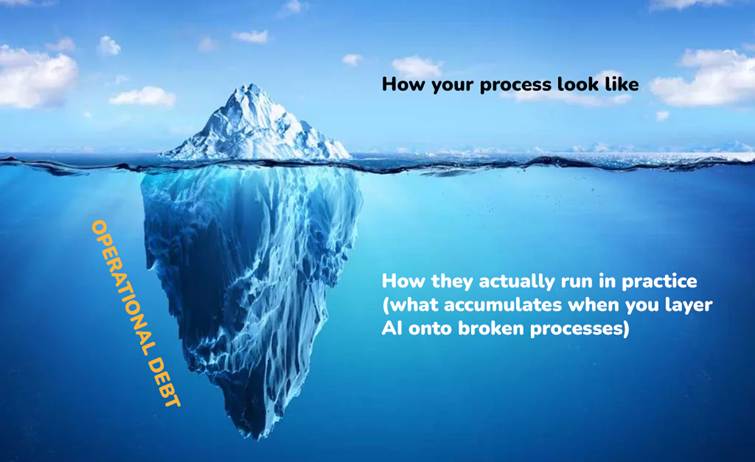
Operational debt.
CASE STUDY 1: How did the lack of data verification procedures lead to an AI error in a restaurant chain?
Restaurant group, 30 locations.
The AI system responsible for demand forecasting and staff scheduling ran automatically every night. It pulled transaction data from all thirty restaurants, and in the morning managers received a ready-made staffing plan for the day. Everyone trusted it completely. The problems began with a small technical change in the network of one restaurant. The point-of-sale system in that location simply stopped sending data. Worst of all, no error message appeared, and the dashboard continued to show a green status.
The algorithm did not realize it had been cut off from information, so it automatically switched to historical averages. Data from previous years showed that this particular restaurant usually had lower traffic on Saturdays in October, so the system recommended minimum staffing. However, the AI had no knowledge of one key fact: for that specific Saturday, the manager had accepted a large catering reservation for 50 people.
The restaurant manager implemented the generated schedule without questioning it. The result? At peak time, the kitchen was short four people, guests waited endlessly, complaints started coming in, and the company had to refund part of the customer’s payment. The most interesting part is that the model itself worked flawlessly – for eleven days, no one noticed it was being fed incomplete data because the company lacked a procedure that could verify it.

CASE STUDY – Restaurant group.
CASE STUDY 2: Why did AI route optimization fail in a logistics company?
Logistics company, 60 vehicles
A logistics company implemented an advanced AI route optimization system and integrated it directly into its dispatching software. In theory, the algorithm calculated the ideal, most cost-effective plan for every delivery. In practice, however, management continued as before – dispatchers assigned tasks manually, relying on their own experience, habits, and relationships with people.
Drivers, in turn, regularly ignored the AI’s recommendations. They summed it up simply: “the system does not know that this exit road always jams at 3:00 p.m.” or “customer X always demands delivery before noon, no matter what the computer says.” The result? From a purely technical perspective, the AI worked perfectly every time and provided optimal parameters. Nevertheless, the entire operational process in the company failed. The project failed not because the technology failed, but because no one had first adapted and fixed the real procedures surrounding it.

CASE STUDY – Logistics company.
Which business dimensions of data quality should be reviewed before starting an AI project?
There are many ways to measure data quality, but six dimensions consistently come to the forefront – and in practice, they are business problems, not technical ones. In the companies we assess, at least three of them are usually already relevant. The question is not whether you have these problems; the question is which ones will matter most for the specific use case you are planning.
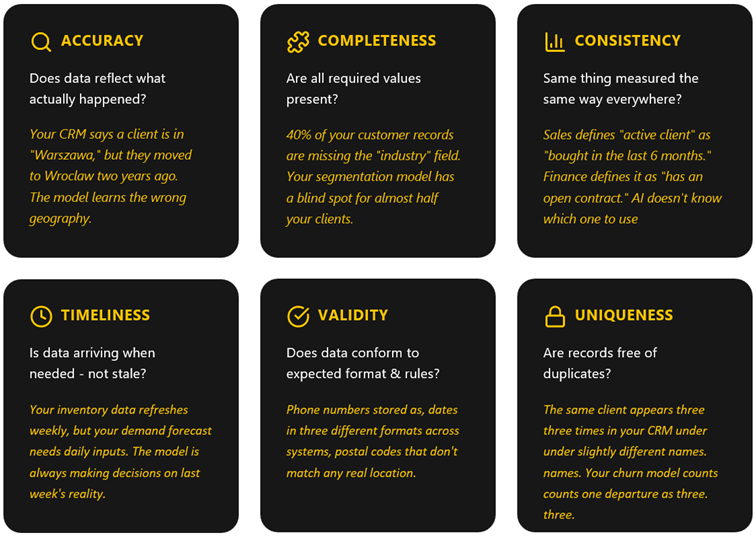
6 dimensions of data quality to check before AI.
What does the state of data readiness look like when it allows for safe AI implementation?
An organization’s readiness to implement AI means being fully aware of existing information gaps, not having a perfect IT system. To safely begin the transformation process, C-level leaders should verify the company’s readiness in three core areas:
- Data readiness: You do not need a perfect data warehouse. You need key data sources in one or two centralized systems, a named owner for each major data set, and basic knowledge of whether the data is complete and consistent. If these three things are in place, you are further ahead than most companies.
- People readiness: You do not need a team of data scientists. You need at least one person acting as an internal translator who understands what AI can and cannot do, plus managers ready to adjust how they work based on AI recommendations. If everyone says, “I’ll check the result, but I’ll do it my own way anyway,” you have a readiness problem.
- Process readiness: Key workflows must be documented – even a shared document is enough. If the only person who knows how onboarding works is on vacation, AI will not help with that process. And your KPIs must mean the same thing to everyone: if sales and finance still cannot agree on what an “active customer” is, no model will reconcile that for you.
Why does investing in data quality and business processes pay off even before AI models are launched?
Investing in data foundations pays off immediately because it brings order to the company’s operating model and generates savings regardless of whether AI algorithms are ultimately deployed. Statistics show that companies succeeding with AI allocate as much as 70% of their budget to preparing people and processes – workflow integration, data preparation, training, change management – around 20% to technology infrastructure, and around 10% to choosing algorithms. Failed projects reverse these proportions, pouring budget into tools and models while data quality and process fit remain unresolved.
Standardizing business definitions and assigning data owners brings measurable gains in just a few weeks:
- Faster reporting: Simply agreeing on a shared KPI definition across sales, finance, and operations makes reports more accurate, reviews faster, and disputes about whose numbers are correct disappear. Some companies reduce the time needed to prepare board materials by around 30% just by agreeing on what “revenue” means.
- Clear accountability: Assigning owners to databases dramatically speeds up the resolution of operational issues within the organization.
- Knowledge security: Documenting the most important processes accelerates employee onboarding and eliminates the risk of losing knowledge when staff leave.
What do managers think about trust in data and KPI consistency in organizations?
During one of DataRiseLab’s webinars, we asked participants two questions. The answers, along with comments from Bartłomiej Ordyk, Senior Business and Systems Analyst at DataRiseLab, say a great deal about where most organizations really are.
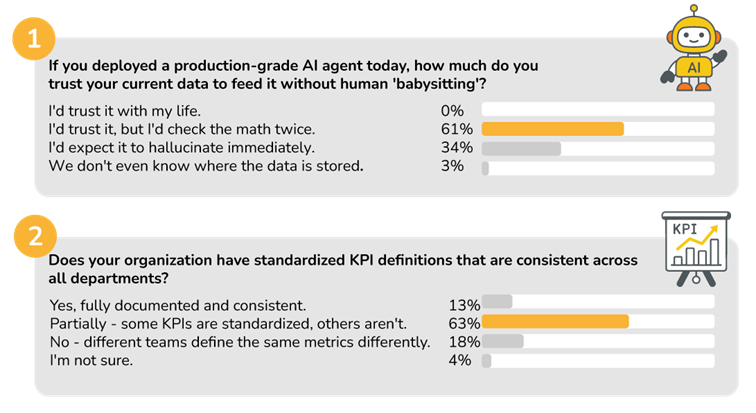
DataRiseLab webinar poll results.
“How much do you trust your current data as a foundation for a production AI agent without human supervision?”
61% of participants said they would check the calculations, and 34% expected hallucinations immediately.
No one trusts their data blindly – and that honesty is a very good starting point. It points to the gap between where your data is today and where it needs to be to support AI, and that gap can be fixed. In our experience, companies that notice this early save the most time and budget because they invest in the foundations before committing to costly pilots. – Bartłomiej Ordyk, Senior Business and Systems Analyst, DataRiseLab
“Do you have standardized KPI definitions that are consistent across all departments?”
63% answered “partially,” while another 18% admitted that different teams define the same metrics differently.
If sales and finance define “active customer” or “margin” differently, every model you build will optimize for different things in different parts of the business. This is not an AI problem – it is a definitions problem. Without consistent KPIs, you cannot measure whether AI is delivering value or simply creating noise faster. – Bartłomiej Ordyk, Senior Business and Systems Analyst, DataRiseLab
What are the key takeaways for business leaders planning to implement AI?
If you remember five things from this article, let them be concrete business guideposts for your management team:
- Technology is not the bottleneck. Modern AI models work extremely well. Failures come from data unreadiness and broken processes – 85% of AI models fail because of poor or missing data.
- Bad data is already costing you. Low data quality consumes millions in operational structures every year before technology even enters the conversation. AI does not create this problem – it simply accelerates it.
- Do not automate chaos. AI exposes and amplifies operational debt instead of fixing it. First diagnose the company’s situation carefully, then narrow the scope to two or three use cases that matter most to the business.
- Preparation pays for itself. Agreeing on KPI definitions, assigning data owners, and documenting key processes deliver real business value within weeks – regardless of whether any AI model is ultimately built.
- Honest self-assessment is the right starting point. The gap between where your data is today and where it should be is completely fixable. Spotting it early saves the most time and budget.