Modern Workplace as a Foundation for AI: How to Prepare Your Company for the Era of Artificial Intelligence?

Without the Right Foundations, More AI Tools Lead to Information Chaos – Not Efficiency.
Most organizations today don’t struggle with a lack of tools. Quite the opposite – they have too many. Instant messaging apps, shared drives, task management systems, and yet another “AI” platform. Each promises greater efficiency, faster decisions, and better collaboration. In practice, however, many companies experience the opposite: information chaos, meeting overload, and difficulty enforcing decisions.
At the same time, management teams are increasingly asking themselves whether and how to use AI in their organizations’ daily work. Expectations are high – automation, decision-making support, and a real increase in productivity. However, the reality is more complex. AI doesn’t operate in a vacuum. It relies on data, access to information, context, and clearly defined rules of collaboration. If these foundations are unstructured, even the best AI tools will fail to deliver the desired results.
Therefore, before an organization starts thinking about artificial intelligence, it is worth asking itself another question: is our way of working ready for it?
What is Modern Workplace and why should it not be treated solely as an IT project?
This is where the concept of the Modern Workplace comes in. Modern Workplace is often reduced to a list of tools. Many companies, therefore, believe that because these solutions are already in place, the modern work environment is a done deal. The problem is that Modern Workplace isn’t just about implementing an application. It’s about standardizing how we work within an organization – answering questions about how we work with information, how we collaborate across teams, and how we make decisions, regardless of location or work model.
From a business perspective, Modern Workplace is a coherent operating model that combines:
· team communication and collaboration,
· document and knowledge management,
· secure access to resources,
· access control, security, and compliance,
· clear rules and accountability for information.
The key point is that Modern Workplace isn’t an IT project. IT provides the platform and manages security, but the business defines the rules of the game: what constitutes “one version of the truth,” where documents are created, how project collaboration works, and how we protect knowledge. Organizations without these rules suffer from the same pattern: each team works “in their own way,” documents circulate in emails, decisions get lost after meetings, and new employees spend weeks trying to understand “where everything is.” Where Modern Workplace is well-designed, work becomes predictable, scalable, and understandable.
What operational problems and business challenges in a company’s daily work does a well-designed Modern Workplace model solve?
For management, Modern Workplace only makes sense if it solves specific operational problems. In the organizations we work with, these problems recur surprisingly often – regardless of industry or country of operation.
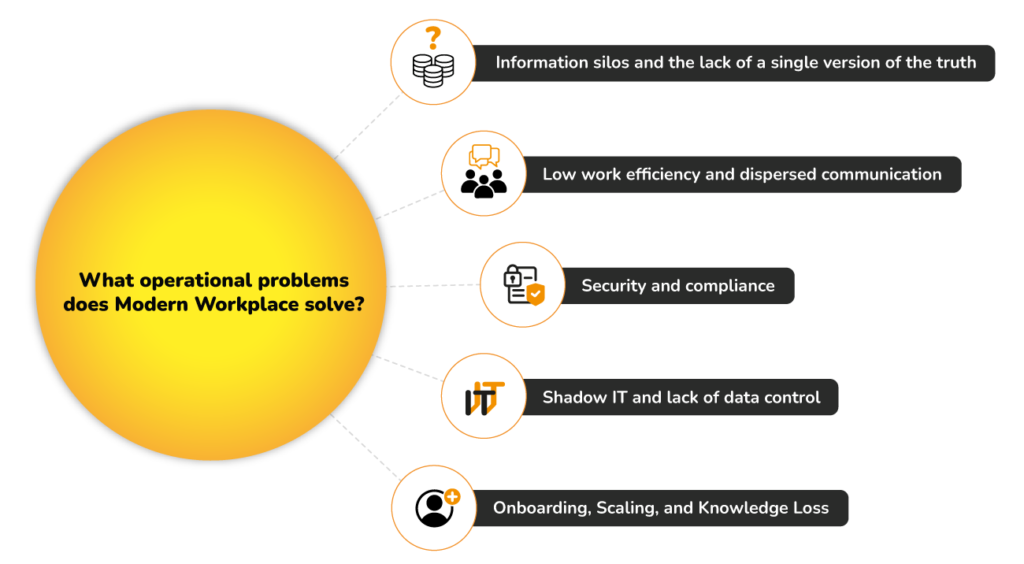
Information silos and the lack of a single version of the truth
In many companies, information exists simultaneously in several places: emails, network drives, the cloud, and instant messaging applications. Technically, everything “exists somewhere,” but in practice, no one is certain which version of a document is current and where the knowledge needed to make decisions resides. The business consequences are simple: delays, operational errors, and conflicts resulting from working with outdated data. Modern Workplace introduces clear rules – a single source of truth, clear locations for document storage, and accountability for information. This ensures that decisions are based on facts, not speculation.
Low work efficiency and dispersed communication
In organizations without a coherent work model, meetings often replace real workflow. Statuses are discussed instead of documented, decisions are made verbally, and accountability is blurred between teams. Employees work side by side, not collaboratively. The result is decreased productivity, information fatigue, and difficulty scaling the organization. Modern Workplace streamlines these elements. This translates into fewer meetings, more real work, and greater operational predictability.
Security and compliance
The lack of clear rules for working with information is not only a problem for efficiency but also a real business risk. Sensitive data sent via email, uncontrolled file sharing, and a lack of visibility into who has access to what information significantly complicate compliance with security requirements and regulations. Modern Workplace introduces security “in the background” – as part of a standard way of working, rather than a set of restrictions. Clear access rules, information classification, and sharing controls allow organizations to act faster while minimizing legal and reputational risks.
Shadow IT and lack of data control
Where official tools don’t meet real business needs, employees turn to grassroots solutions: private messaging apps, external drives, and increasingly, AI tools used without any rules. The intentions are good – faster, more convenient – but the consequences can be costly. Modern Workplace limits Shadow IT not with prohibitions, but by providing safe and comfortable work standards that truly support users. When the official work environment is well-designed, the need to “bypass the system” simply disappears.
Onboarding, Scaling, and Knowledge Loss
In companies that are growing or operate in a distributed model, onboarding new employees can be lengthy and frustrating. Organizational knowledge is hidden in the minds of experienced employees, and its loss upon departure is increasingly felt. Modern Workplace organizes knowledge and processes in a way that allows new people to enter roles more quickly and allows the organization to scale without a proportionate increase in chaos. Knowledge stays within the company, not just in email inboxes.
A well-implemented Modern Workplace doesn’t solve a single problem – it streamlines the entire organizational work model. This is precisely why it becomes the foundation for subsequent stages of transformation, including the conscious use of AI.
CASE STUDY: How did organizing document work within Modern Workplace help a QSR restaurant chain regain full control of its operations?
One of the most common and yet most underestimated problems is the previously mentioned existence of multiple versions of the same document within a company. This is a source of operational errors, inconsistent actions, and loss of control over information, especially in distributed or networked organizations.
The following example shows what this problem looked like in practice in an organization from the QSR industry and how it was solved – not by implementing another tool, but by organizing the model of working with documents within the Modern Workplace.
Business Problem
The organization was grappling with a recurring yet critical operational problem: different versions of the same documents running concurrently across the company.
This primarily affected:
· restaurant operating procedures,
· job manuals,
· training materials,
· HR and compliance documents.
Files were distributed via email, stored on network drives, and in managers’ private folders. Each update resulted in a new version of the document, with no clear indication of which version was the current one.
Operational Impact
From the management’s perspective, the problem wasn’t technical in nature, but strictly business-related:
· restaurants were operating under different versions of the same procedures,
· new employee onboarding was inconsistent and time-consuming,
· there was no real control over what information was actually used in operations.
Importantly, the organization didn’t lack tools. The problem was the lack of a single, clearly defined source of truth and a lack of rules for working with documents.brak narzędzi. Problemem był brak jednego, jasno zdefiniowanego źródła prawdy oraz brak reguł pracy z dokumentami.
Management Decision and Implementation Results
ZamiaInstead of reinforcing email communication or creating further process workarounds, the organization decided to streamline its document management model.
Key assumptions:
· Documents exist in one central location,
· Each document has a business owner,
· A single, current version applies,
· Access to documents is uniform across the entire organization.
SharePoint was used not as “another drive,” but as a central knowledge repository with clear rules for publishing and updating content. After implementing a consistent document workflow, the organization resolved fundamental issues and, importantly, gained control over information and its timeliness.
The most important change was not in the technology, but in the way knowledge was handled. The organization gained a single source of truth, which became a natural point of reference for the entire network..
Which key Microsoft tools are responsible for changing the way organizations work?
A modern workplace doesn’t mean implementing every available technology. In practice, a few key tools are responsible for most of the real change in the way we work. Below is a list of those that, in various configurations, form the foundation of a modern work environment.
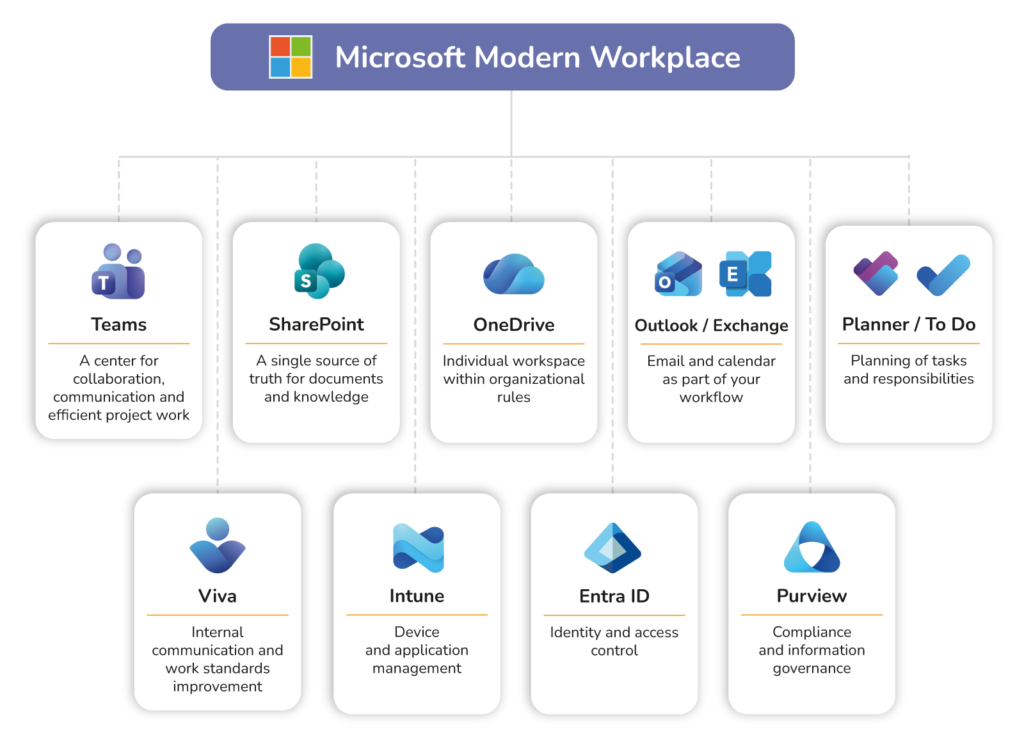
1. Microsoft Teams – A team collaboration hub – a single space for communication, meetings, and project work. In a mature environment, it’s a “team workplace,” not just another messaging app.
2. SharePoint Online – A single source of truth for documents and knowledge – structure, versioning, and accountability for content. This is the foundation for eliminating file chaos and disputes over the “current version.”
3. OneDrive for Business – A space for individual work within organizational rules – organizes personal files and facilitates the transition from individual to shared work without multiplying copies.
4. Outlook / Exchange Online – Email and calendar as part of the workflow – a channel for coordination and communication, not a repository of knowledge and decisions.
5. Planner / To Do – Visibility of tasks and responsibilities – a shared view of “who does what” without process overload and excessive status meetings.
6. Microsoft Viva – Internal communication and strengthening work standards – supporting onboarding, reinforcing practices, and building cohesion within the organization.
7. Microsoft Intune – Device and Application Management – Enforce security policies on user devices in a predictable manner for IT and business.
8. Microsoft Entra ID – Identity and Access Control – Consistent login and permission policies as a prerequisite for secure hybrid work.
9. Microsoft Purview – Compliance and Information Governance – Data classification, sharing control, and content lifecycle control. Critical for organizations seeking to securely scale AI.
It is worth emphasizing: the strength of Modern Workplace does not come from the number of tools, but from their consistent use in a single work model – with clear rules, responsibility and “one version of the truth”.
Why does artificial intelligence need the stable foundations of a Modern Workplace to deliver real business value?
As an organization organizes its workflow, tools, and information within the Modern Workplace, another question naturally arises: what should the next step be? For many companies today, the answer is AI. However, it’s worth considering this in its proper order. AI isn’t a separate project or a “technological add-on” to the existing environment. It’s a consequence of how work, information, and access are organized within the company. Therefore, AI doesn’t fix organizational chaos – it reinforces it. If a company has conflicting document versions, unclear access policies, and fragmented knowledge, AI will replicate these inconsistencies.
For AI to deliver real value, it needs the foundations built by the Modern Workplace:
· Trusted data – a single version of the truth, up-to-date documents, and clear sources of information.
· Access control – AI operates within permissions and policies; unstructured access increases risk, not value.
· Organizational context – knowledge embedded in teams and processes, not scattered across channels.
· Security hygiene and compliance – governance, auditability, and rules for working with information are standard, not the exception.
From a C-Level perspective, this means changing the order of operations: first, streamlining the work model, and only then consciously using AI where it makes business sense.
Therefore, the first step on the path to AI isn’t choosing a tool or technology. It’s assessing the organization’s readiness from the Modern Workplace perspective. This is a simple yet highly practical decision: does the company have a “single version of the truth,” are decisions contextualized, and is information managed predictably? Only then can AI become a true business supporter, not another layer of complexity.